
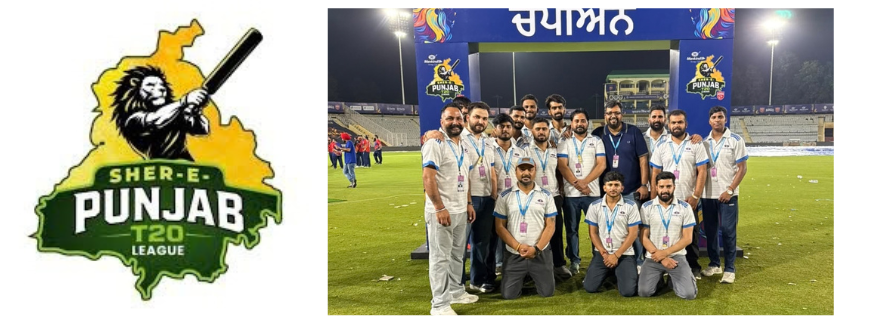
How 3rd-Eye.TV Powered Complete DRS at the Sher-e-Punjab T20 League: 27 Matches, 87-Second Reviews, Zero Missed Referrals
In T20 cricket, one wrong decision can change a match, a points table and sometimes a player's career. At the Sher-e-Punjab T20 League, every decision had the backing of technology. The complete Decision Review System (DRS) was run by 3rd-Eye.TV: the cameras, the tracking, the Sound Sense and the operators in the control room.
Here's how we delivered DRS across all 27 matches, and what the numbers show.
The Sher-e-Punjab T20 League at a glance :
The Sher-e-Punjab T20 League brings together 6 teams from across Punjab. It was played at I. S. Bindra Punjab Cricket Stadium from 30/8/2026 to 13/9/2026. With floodlit matches, live broadcast and a lot of local interest, the organizers wanted umpiring decisions to be as accurate and transparent as the cricket was competitive.
That's where 3rd-Eye.TV came in.
One partner, complete DRS: what our team handled :
Many tournaments rent equipment from one supplier, hire operators from another and hope it all works together on match day. At Sher-e-Punjab, everything came from 3rd-Eye.TV:
* Camera setup: all DRS cameras were ours, installed and aligned around the ground by our crew.
* Ball-tracking: LBW-style trajectory graphics on live deliveries, showing pitching, impact and whether the ball would hit the stumps.
* Sound Sense edge detection: audio-spike graphics, checked frame by frame, to confirm or rule out edges.
* DRS control room: a dedicated team on multiple monitors, running every review alongside the live stadium feed.
* Trained operators: our own crew, on site for every match.
With a single team responsible for the whole system, there were no hand-offs between vendors and no gaps in accountability.
From high-speed captures to frame-by-frame precision :
1. High-speed cameras
A cricket ball can travel from the bowler's hand to the batter in under half a second. Our high-speed cameras record that moment in fine detail, capturing the bowler's release, the bounce and the impact. The review team then has clear footage to work from.
2. Ball-tracking for LBW decisions
For LBW referrals, our ball-tracking system plots the ball's path and projects where it would have gone. The umpire, players and viewers can see exactly where it pitched, where it hit the pad and whether it would have gone on to hit the stumps.
3. Sound Sense for edges
Some of the toughest calls in cricket are thin edges. Sound Sense lines up the audio with the video frame by frame. A spike in the waveform as the ball passes the bat gives the third umpire clear evidence of an edge.
4. DRS execution: inside the control room
Behind every review on the big screen was a control room full of our operators working across several screens. When a player or umpire asked for a review, the team:
Pulled up the right camera angles immediately.
Ran ball-tracking or Sound Sense, depending on the type of appeal.
Delivered a clear graphic to the third umpire and the broadcast.
Doing this quickly and calmly, match after match, takes practice, discipline and a system built for live cricket.
The numbers that matter :
Metric Result
Matches covered - 27
Total DRS reviews - 132
Average review time - 87 seconds
Fastest review - 19 seconds
Missed referrals - Zero
Why these numbers matter:
* 87 seconds on average keeps the game moving. Long delays hurt the rhythm of a T20 match and annoy spectators and broadcasters.
* A 19-second fastest review shows what's possible when the cameras, software and operators work as one system.
* No missed referral, no missed review. Every review requested during the tournament was delivered, across all 27 matches.
What this means for leagues and cricket boards
The Sher-e-Punjab T20 League shows that professional DRS isn't only for international cricket. Domestic and franchise-style leagues can offer the same standard of decision review as the big tournaments, provided they have the right partner.
For organizers, that means:
* Fairer results: fewer wrong decisions deciding matches.
Better broadcasts: ball-tracking and Sound Sense graphics make the coverage more engaging.
* More credibility: players, sponsors and fans take a tournament more seriously when it uses professional review technology.
Frequently asked questions:
What is DRS in cricket?
DRS (Decision Review System) is technology that lets players or umpires challenge an on-field decision. It uses high-speed cameras, ball-tracking and edge detection such as Sound Sense, and the third umpire reviews the evidence before making the final call.
How long does a DRS review take?
At the Sher-e-Punjab T20 League, 3rd-Eye.TV's average review took 87 seconds, and the fastest took just 19 seconds.
Can domestic leagues use DRS?
Yes. 3rd-Eye.TV provides complete DRS for domestic, state and franchise leagues, including the equipment, setup and trained operators.
Driven by technology, defined by precision
We're proud to have been part of the Sher-e-Punjab T20 League, and grateful to the organizers, the players and our own crew, who made every review count.
Planning a tournament? If you want professional DRS with our own cameras, ball-tracking, Sound Sense and trained operators, we'd love to hear from you.
Location :
Plot no 998, 2nd floor
JLPL Industrial Area Sector 82
Mohali, Punjab
Phone :
+91 9805946666
Email :
info@hpmcsales.com
navneet@hpmcsales.com
Interested in this technology for your matches?
Get a quote for DRS, ball-tracking and match-day cricket technology.